
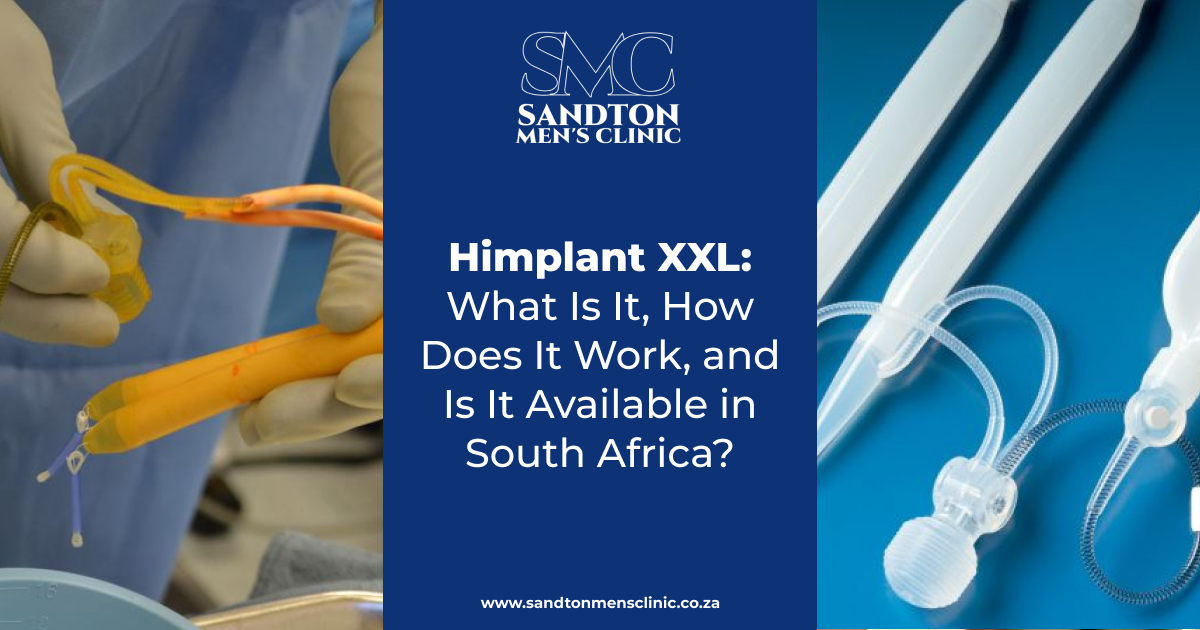
Himplant XXL is one of the most searched surgical penis enlargement topics because it sounds like a direct answer to size concerns. The reality is more serious. Himplant, also discussed in clinical literature as the Penuma implant, is a cosmetic penile implant procedure designed mainly to change flaccid appearance and girth. It is not a treatment for erectile dysfunction, weak erections, low libido, or performance anxiety. Before any man considers an implant, the first step should be a clear assessment of what is actually driving the concern: true anatomical size, erection quality, body composition, confidence, relationship pressure, or unrealistic expectations created by online marketing.
If you are researching Himplant XXL in South Africa, this honest guide explains what it is, what it is not, the risks to understand, and why a non-surgical assessment should come before any irreversible decision.
Start With the Real Concern, Not the Procedure
The most important principle when researching Himplant XXL is that the procedure should never be the starting point. The starting point is understanding the actual concern. Some men are worried about girth. Others believe they are too small because their erections are not fully firm. Some have gained abdominal weight, which can make the visible shaft appear shorter. Others are carrying sexual anxiety, comparison pressure, or shame created by unrealistic online content. These are different problems, and they require different approaches. A cosmetic implant may not address the real issue if the true concern is erectile function, confidence, body composition, or performance pressure.
What Is Himplant XXL?
Himplant XXL refers to a larger sizing option within the Himplant or Penuma cosmetic penile implant range. The device is a soft, pre-formed silicone implant placed surgically beneath the penile skin. Its purpose is cosmetic enlargement, mainly increased flaccid girth and a fuller flaccid appearance. It is important to understand that this is not the same as a penile prosthesis used for erectile dysfunction. Himplant is not designed to create erections, treat weak erections, improve libido, or solve premature ejaculation.
Men researching Himplant often confuse cosmetic enlargement with sexual performance treatment. That confusion can lead to the wrong decision. If your real problem is that your penis is not getting hard enough, you lose firmness during sex, or you feel smaller because your erection quality has dropped, the first step should be an erectile dysfunction assessment or weak erection consultation, not cosmetic surgery.
FDA-Cleared Does Not Mean Risk-Free
One of the phrases men see online is that Himplant or Penuma is FDA-cleared. This matters, but it must be understood correctly. FDA 510(k) clearance means a device has been cleared through a regulatory pathway showing substantial equivalence to a legally marketed device. It is not the same as saying every marketing claim has been independently proven, and it does not mean the procedure is risk-free. The FDA listing for K181387 identifies the device as a Pre-Formed Penile Silicone Block. Men should understand the difference between clearance, approval, marketing claims, and real-world surgical outcomes before making any decision.
What Himplant XXL Can and Cannot Do
Himplant XXL may increase the appearance of flaccid girth because the implant adds volume under the penile skin. Some men may also notice a fuller flaccid hang. However, the procedure does not reliably increase erect length, does not change the erectile chambers, and does not treat the blood-flow or nerve mechanisms involved in achieving a firm erection. In practical terms, Himplant is a cosmetic girth procedure, not a male performance treatment.
This distinction matters because many men searching for enlargement are actually describing erection quality concerns. A fully firm erection naturally appears larger than a partial or weak erection. If a man has incomplete firmness, improving erection quality may make a more meaningful difference to his confidence and sexual experience than a cosmetic procedure. Our related guide on penis enlargement natural methods explains why realistic assessment matters before spending money on any enlargement pathway.
The Surgical Reality: What the Procedure Involves
Himplant surgery is not a quick wellness treatment. It is a surgical procedure performed by a qualified surgical provider in a sterile operating environment. The implant is placed under the penile skin and positioned around the shaft. Men may need circumcision before or during the procedure, depending on the surgeon’s requirements and their anatomy. Recovery can involve swelling, bruising, wound care, restricted activity, follow-up visits, and a period without sexual activity. The exact timeline depends on the surgeon, the patient’s healing, and whether complications occur.
Any man considering this procedure should ask a qualified urologist or appropriately trained surgical specialist about their case volume, complication rates, device authenticity, regulatory compliance, revision policy, and what happens if the implant must be removed. A decision like this should not be based on marketing images, online testimonials, or pressure from sales-driven consultations.
Risks Every Man Should Understand
Every surgical implant carries risk. With Himplant or similar cosmetic penile implants, important risks to discuss include infection, wound healing problems, implant displacement, irregular contour, asymmetry, erosion or extrusion, changes in sensation, pain, dissatisfaction with appearance, and the need for revision or removal. Removal is not the same as returning to your original state, because scar tissue and tissue changes may occur after implantation and healing.
This is why informed consent matters. A man should understand best-case outcomes, average outcomes, worst-case outcomes, and what recovery or revision could realistically involve. If a provider cannot clearly explain these points, or if they make the procedure sound simple and risk-free, that should be treated as a warning sign.
To help clarify whether your current focus should be surgery, sexual function, or a proper assessment, here is a brief self-check. This confidential self-check takes about one minute.
Himplant Decision Self-Check
5 quick questions, about 60 seconds, completely private. This is a self-reflection tool, not a diagnosis or surgical recommendation.
1. Is your main concern specifically girth or flaccid appearance, rather than erection quality?
2. Do you already have consistently firm erections without ongoing ED or weak erection concerns?
3. Have you already explored realistic non-surgical options and received professional guidance?
4. Do you fully understand that implant surgery can involve complications, revision, removal, and unpredictable post-removal outcomes?
5. Would you value an independent, confidential assessment before making any irreversible decision?
Is Himplant XXL Available in South Africa?
Availability can change, so men should verify directly with qualified surgical providers and relevant regulatory bodies rather than relying on online claims. Any South African provider advertising Himplant, Penuma, or a similar penile implant should be asked whether the device is genuine, whether it has appropriate regulatory status for local use, whether the surgeon has formal training in that specific technique, and what their documented complication and revision rates are. If the procedure is only available through selected overseas providers, travel, follow-up care, emergency complications, revision surgery, and aftercare logistics must all be considered.
Who Might Be a Candidate?
A possible candidate for a cosmetic penile implant is usually a man with normal erectile function, realistic cosmetic goals, clear understanding of risks, stable psychological expectations, and access to a qualified surgeon with specific experience in penile implant procedures. Even then, suitability can only be decided through surgical consultation. Men with untreated erectile dysfunction, weak erections, active penile skin problems, uncontrolled health conditions, unrealistic length expectations, or significant body-image distress are usually not suitable starting candidates until those concerns are properly assessed and managed.
Why Non-Surgical Assessment Should Come First
For many men, the most valuable first step is not surgery. It is understanding whether the concern is actually size, firmness, confidence, weight-related visibility, or sexual performance. Non-surgical assessment can identify whether improving erection quality, addressing stress, supporting testosterone naturally, improving body composition, or using realistic traction-based approaches may be more appropriate. Sandton Men’s Clinic focuses on non-surgical penis enlargement support, men’s sexual health assessment, and honest expectation-setting before any man considers higher-risk pathways.
How Sandton Men’s Clinic Approaches Himplant Questions
At Sandton Men’s Clinic, Himplant XXL conversations start with assessment, not pressure. Led by George Mulaudzi, a naturopath, our premium men’s wellness practice helps men understand what is driving their concern and what options are realistic. As a naturopathic practice, we do not perform surgery, do not place penile implants, and do not present surgical procedures as quick fixes. Where a surgical opinion is genuinely appropriate, men should be referred to suitably qualified medical specialists. For men across Sandton, Johannesburg, Midrand, Waterfall City, Fourways, Randburg, Rosebank, Pretoria, Centurion and Gauteng, we provide confidential, non-surgical guidance before irreversible choices are made.
The Honest Bottom Line
Himplant XXL is a serious surgical cosmetic option, not a general men’s performance treatment and not a cure for erectile dysfunction. It may be relevant to a narrow group of men with normal erectile function and realistic cosmetic girth goals, but it carries surgical risks and should only be considered after proper assessment, informed consent, and discussion with a qualified surgical specialist. For many men, the real concern is not true size but erection quality, confidence, body composition, or expectation pressure. A confidential, non-surgical consultation can help separate what is realistic from what is risky before any man commits to an irreversible procedure.
Frequently Asked Questions
What is Himplant XXL?
Himplant XXL refers to a larger sizing option within the Himplant or Penuma cosmetic penile implant range. It is a soft silicone implant placed surgically beneath the penile skin to improve flaccid girth and appearance. It is not a treatment for erectile dysfunction.
Is Himplant the same as an erectile dysfunction implant?
No. Himplant or Penuma is a cosmetic penile implant for appearance and girth. An erectile dysfunction implant, also called a penile prosthesis, is a different medical device used in selected men with severe ED under specialist urological care.
Does Himplant XXL increase erect length?
It does not reliably increase erect length. The procedure mainly affects flaccid appearance and girth because the implant sits beneath the penile skin rather than changing the erectile chambers or the structures that determine erect length.
Is Himplant XXL available in South Africa?
Availability may change, and men should verify this directly with qualified surgical providers. Any provider advertising Himplant or a similar implant in South Africa should be asked about device authenticity, surgeon training, regulatory compliance, complication rates, and revision policy.
What are the risks of Himplant surgery?
Risks can include infection, swelling, wound healing problems, implant movement, irregular contour, asymmetry, changes in sensation, pain, dissatisfaction, revision surgery, removal, and unpredictable outcomes after removal. These risks should be discussed carefully with a qualified surgical specialist.
Should I treat weak erections before considering Himplant?
Yes. If you have weak erections, erection loss, reduced firmness, low libido, or performance anxiety, those concerns should be assessed before cosmetic enlargement surgery is considered. Himplant is not designed to treat erectile dysfunction.
What non-surgical options should men consider first?
Depending on the concern, non-surgical options may include improving erection quality, addressing lifestyle and body composition, reviewing testosterone and vitality factors, managing stress and performance anxiety, and discussing realistic traction-based approaches. The right starting point depends on the individual assessment.
Himplant XXL should be approached with caution, realistic expectations, and professional guidance. If you are unsure whether your concern is size, erection quality, confidence, or something else, start with a confidential assessment before making an irreversible decision.
Get an honest assessment before considering implant surgery
Book a confidential consultation with Sandton Men’s Clinic for a non-surgical, root-cause assessment of your size, confidence, erection quality, and men’s wellness concerns.
📞 +27 10 205 9208 | Book online (24/7 availability)
Reviewed by George Mulaudzi, Naturopath, Sandton Men’s Clinic. General information only, not a substitute for personalised medical or surgical advice. Himplant, Penuma, and similar penile implant procedures are surgical cosmetic procedures and should be discussed with a qualified urologist or appropriately trained surgical specialist. Sandton Men’s Clinic is a naturopathic men’s wellness practice that does not perform surgery, place penile implants, prescribe medication, or provide testosterone replacement therapy. Naturopathic care complements but does not replace conventional medical or surgical care. Always consult a qualified healthcare provider regarding your specific health concerns.